The Breda Crates Van Gogh Recovered Paintings
The Breda Crates comprised of around sixty Vincent van Gogh paintings, one hundred and fifty loose canvas artworks, eighty pen illustrations, and between one and two hundred crayon drawings. Dispersed without charge, sold for a nominal amount, or put up for auction.
Vincent relinquished this volume of work upon relocating to Paris, which over time allowed others to assert ownership.
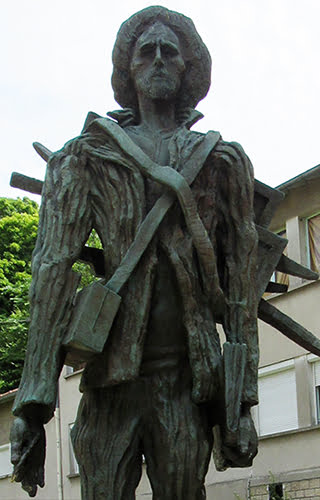
He originated from a household of middle- to upper socioeconomic status. Nevertheless, he chose to spend his formative years residing in rural destitution with the peasant laborers and coal miners of Borinage, Belgium. He served as a missionary in Borinage, but when ecclesiastical officials learned of his impoverished living conditions, they dismissed him for allegedly compromising the sanctity of the priesthood. He was a Protestant in a predominantly Catholic environment.
Despite being a distressing ordeal for Vincent, it ultimately proved to be a hidden advantage.
Vincent returned home to his parents’ residence in Etten but soon departed for The Hague, where he learned oil painting techniques from his cousin by marriage, Anton Mauve. Until this point, Vincent had utilized reeds, pens, ink, chalk, pencils, and watercolors.
The first Van Gogh “masterpiece” executed in oils on canvas was created in April 1885 while Vincent resided with his parents in Nuenen at the parsonage. The artwork depicted a rural life tableau, including the de Groot family, commonly referred to as ‘the potato eaters.’ Vincent chooses to depict the plight of these industrious individuals whom he deeply respected and with whom he formed a close bond. The Potato Eaters painting gave Vincent the credibility he needed to warrant a career as an artist.
Vincent, having received permission from his Protestant minister father to utilize the parsonage annex as a studio, established himself there but frequently traveled to other locations to paint. Occasionally, he would journey for several days to smaller towns and villages where he would engage in plein-air painting. One of the towns was Eindhoven, which is likely the setting where he created “Hut with man coming home” (JH 824). “Woman with Goat” (JH 823), “Dilapidated Barn and a Bending Woman” (JH 825), and “Hut with Digging Woman” (JH 803), among others.

In late 1885, Vincent departed from Nuenen and journeyed to Antwerp in Belgium, leaving behind numerous drawings and paintings for his return. Rather than returning, he opted to relocate to Paris to reside with his brother, Theo. One year later, his mother Anna Cornelia van Gogh-Carbentus decided to also leave Nuenen and relocate to Breda, where she leased the higher level of a house for herself, her daughter Wil (Wilhelmina), and Vincent’s youngest younger brother, Cor.
Due to the considerable reduction in size of their new living quarters, Anna-Cornelia opted to store part of her furniture and boxes in storage with a local carpenter, named Adrianus Schrauwen. Among these possessions were containers of Vincent’s wood engravings, literature, artworks, and sketches.
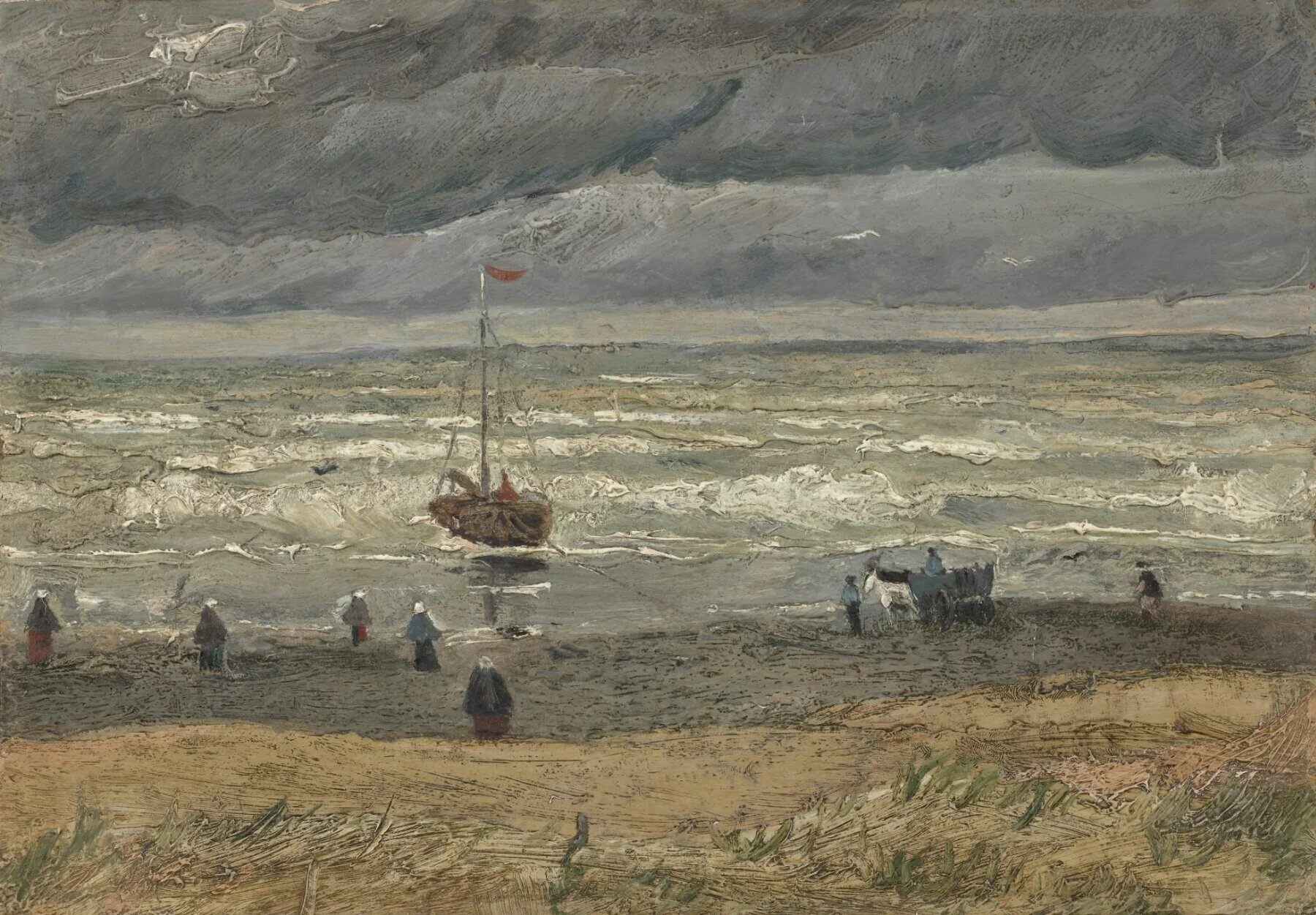
When Theo visited his mother and sister in Breda in the summer of 1887, and aware that Vincent was very attached to his wood engravings, he retrieved them for him but left the paintings and drawing studies behind.
In April 1888, Anna Cornelia and Wil relocated to a more modest residence featuring a garden on the Nieuwe Haagdijk. Carpenter Schrauwen assisted them with their relocation utilizing his horse-drawn cart, but, after downsizing once more, they had to leave Vincent’s crates with Schrauwen. They unsealed the crates to dismantle the wood and stored all of Vincent’s work loosely in the attic of Adrianus Schrauwen. It is believed that remnants of woodworm were discovered in the containers.
As time progressed, carpenter Schrauwen regarded himself as the legitimate proprietor of Vincent’s creations due to their abandonment. The collection of drawings, sketches, and paintings constituted Vincent’s whole Dutch body of work. Certain paintings were affixed to wooden bars, while numerous others consisted of unstretched painted canvases.
In 1902, Schrauwen met a local merchant called J. C. Couvreur, who intended to acquire some antiquated brasswork from the carpenter. In the course of their negotiation for a reasonable price, Schrauwen acquiesced to an offer contingent upon the disposal of Vincent’s accumulated work, which was derogatorily labeled as “rubbish. Crayon illustrations were deemed devoid of genuine worth and so were ripped apart and discarded immediately. Couvreur kept Vincent’s artwork in the basement of his residence located on Stallingstraat in Breda. Although the nude images deeply disturbed Mrs. Couvreur, they were repurposed into paper at the Tilburg paper mill.
After a while, merchant Couvreur contacted a dealer in Rotterdam called De Winter with the hopes of selling Vincent’s paintings but was told they were of no value. With this, Couvreur decided to try his luck by selling them at a local flea market where he had a cart. In a Telegraaf newspaper article he stated:
I have stood on the market with a cart for thirty years. I pinned the drawings and paintings of Van Gogh on the cart with thumbtacks and anyone could have one for ten cents. Sometimes I gave them to the children on the street to play with. One of those pieces I had to buy back later for seventy-five guilders.”
In a separate article from February 1950, he informed the Breda newspaper, De Stem, that he had also provided several paintings to Frans and Willem Meeuwissen, proprietors of the café located at the intersection of Ginnekenstraat and Stallingstraat, which they displayed behind the counter and sold for 5 and 10 cents, or distributed to patrons.
The remainder of Vincent’s elusive paintings were acquired by Mr. Kees Mouwen, a nearby tailor who recognized a bargain and obtained them for only a few cents, and Willem van Bakel. Mouwen reached out to art connoisseur and collector Hendricus Peter (Henk) Bremmer, who ascribed the complete collection to Vincent van Gogh and subsequently recommended consigning the pieces via Gallery Oldenzeel in Rotterdam.
Shortly thereafter, the Nieuwe Rotterdamse Courant published an article about the now renowned Vincent Van Gogh. Couvreur hurried to attempt to repurchase many of the artworks he had previously sold to the villagers in order to resale them at an elevated price.
Numerous occurrences from this time period evoke a sense of dread. Carpenter Schrauwen reportedly gave 13 paintings to a female acquaintance, enabling her to utilize them for patching wall openings by affixing them over the exposed areas. Upon discovering the paintings, Couvreur acquired them from the woman for 100 guilders and subsequently sold them to Mouwen for 300 guilders.
The majority of the artworks acquired by Mouwen were restored by an artist named Van Loon. Mouwen subsequently reached out to an art specialist residing in The Hague, Hendrik Bremmer. Bremmer ascribed the complete collection to Van Gogh and advised Mouwen to have the paintings commissioned by art dealer Oldenzeel in Rotterdam. Some fifty paintings were used for a series of exhibitions in January, May, and November of 1903.
Upon discovering the exhibitions, Jo Van Gogh-Bonger, Theo’s widow, hired attorney J.M. Jolles to investigate, asserting that her son, Vincent’s nephew, was the legitimate heir. The trio of exhibitions sparked considerable debate mostly because the Van Gogh family was unaware of the existence of these works, particularly Jo Van Gogh Bonger.
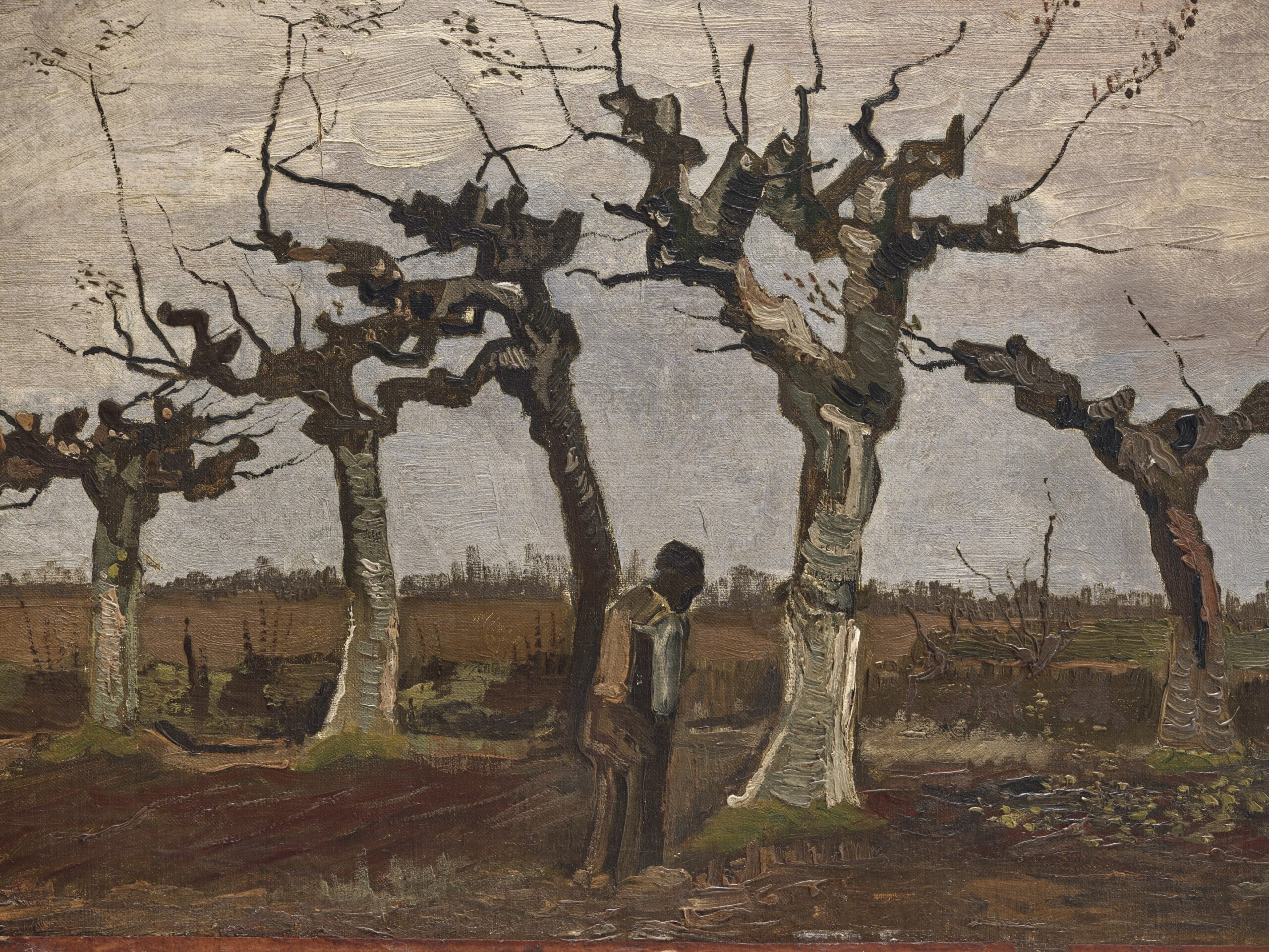
The inquiry concluded that the artworks originated from the studio Vincent abandoned in Nuenen; nevertheless, during this evaluation, Mouwen sold any remaining pieces at the Frederik Muller auction house in Amsterdam. Regrettably for Mouwen, the auction was disappointing, with merely 11 pieces sold. Attorney Jolles instructed him to remove all items except for the 11 that were sold, for which Jo’s son, Vincent Willem Van Gogh, obtained a percentage. Attorney Jolles’ investigative notes assert that Willem Van Bakel also obtained a share from the sale.
Apparently, the names of all buyers were not recorded, just as some of the paintings exhibited for sale at the Oldenzeel gallery are missing from the De la Faille 1928 or 1970 catalog raisonné.
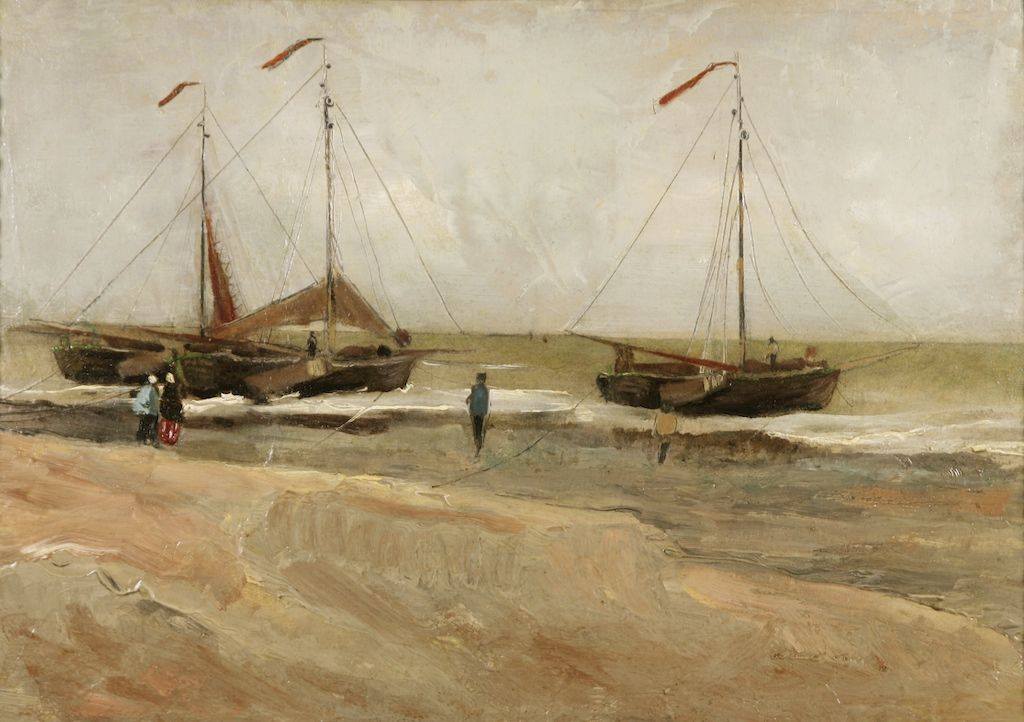
Beach at Scheveningen in Calm Weather
Vincent wrote about this painting in a letter to Theo on August 10, or 11, 1882, which also included a sketch of the study.
Robert Kierlin, an American businessman and former politician, purchased Beach at Scheveningen in Calm Weather at auction for $2,833,000 and then exhibited the work at Minnesota’s Marine Art Museum in Winona from 2010 to 2022.
Women Mending Nets in the Dunes – August 1882
Between 1902 and 1904, Ribbius Peletier acquired 8 of Vincent’s artworks from his Dutch era during the Oldenzeel exhibits. He opted for mending the nets rather than the Peat Barge, as well as Evening twilight in autumn, Shepherd with flock beneath a stormy sky, Watermill at Gennep, and Woodgatherers in the snow.
The five aforementioned paintings, acquired in 1903, originated from the Breda Crates. The seascape at Scheveningen, which Ribbius Peletier also acquired, originated from the Breda Crates.
On Friday, 28 September 1883, Vincent had written to Theo that he had left “more than 70 painted studies lying in The Hague: “Ik heb te s’Hage meer dan 70 geschilderde studies liggen– waren die maar van hier, ik zou er ook meer aan hebben gehad.–”
I have more than 70 painted studies lying in The Hague — if only they were of here, they’d have been of more use to me.
Some of these paintings were part of the Breda Crates.
Vincent painted In the Dunes (In de Duinen) in September 1883 whilst living in the Hague – The painting had been in private collection for several years and was auctioned off by Christies in November 2014 for a sum of $1,805,000.
Of the 70 oils Vincent painted during this period, Christies noted that “only twenty-four have been catalogued thus far, including some known only through old photographs. Van Gogh painted a group of thirteen oils during August 1882, and another nine beginning in July the following summer–including the present landscape (left)–plus two others whose medium is uncertain“. Provenance: Oldenzeel Art Gallery, Rotterdam (1904).
Furthermore, during Vincent’s residence in Antwerp, Belgium, above a small paint dealer’s shop, it is thought that he produced at least 16 paintings—only 7 of which survive, along with several drawings. In Jo Van Gogh-Bonger’s memoir of Vincent, she indicates that he probably entrusted them to his landlord to settle any obligations prior to departing for Paris to reside with Theo. It is probable that certain works were painted over, as exemplified by the Terrace and Observation Deck at the Moulin de Blute-Fin, Montmartre, which covers a depiction of residences that Vincent painted from his staircase in Antwerp.
Vincent also traded his paintings with other artists such as Emile Bernard, Pissarro, Toulouse-Lautrec, Gauguin, and others. The exact number of paintings he traded is unknown, as is the exact number of paintings Vincent gave away to friends and acquaintances throughout his brief career.